Climate catastrophe, the COVID response
COP26 failed, is our civilisation doomed? How might our civilisation respond when the climate crisis reaches everyone?

Setting the scene
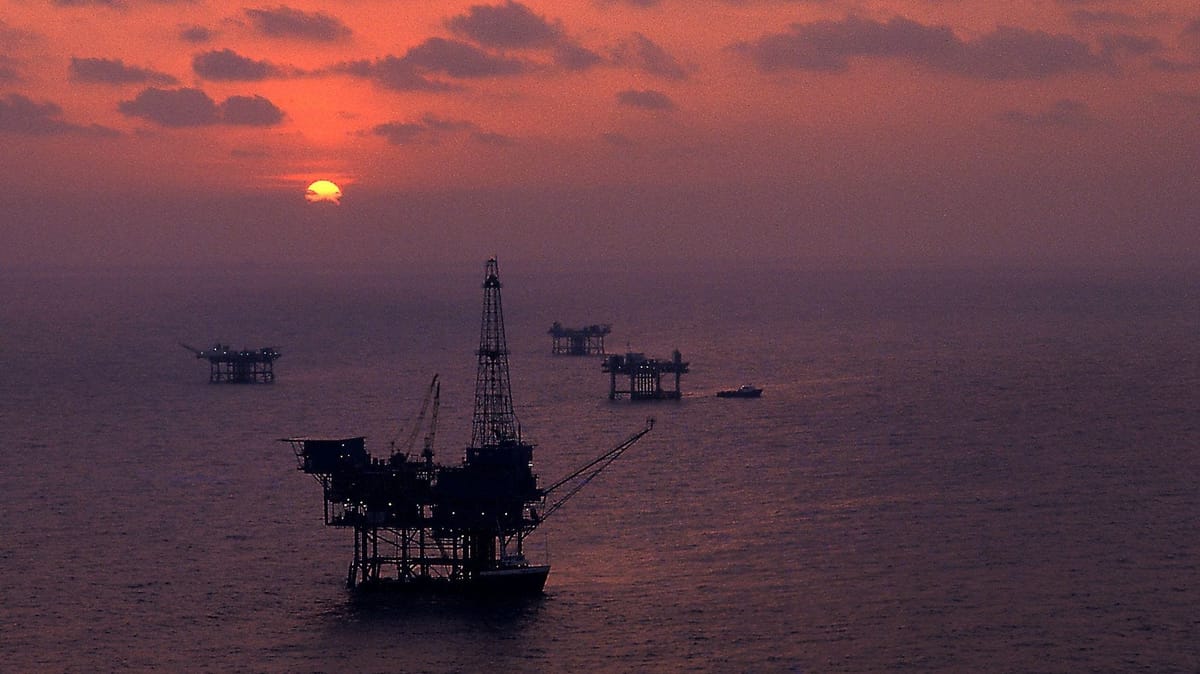
Days after COP26 concludes with no binding agreements reached, the US and China double down on oil & coal:
"...the [US] administration prepares to hold the largest offshore oil and gas lease sale in U.S. history on Nov. 17."
The USA continues to "lead on climate"...
— Greta Thunberg (@GretaThunberg), Sun Nov 14 17:38:26 +0000 2021 source
China state-affiliated media:
China’s Mega Infrastructure 🚞
The 1,813km Haoji Railway, the world’s longest heavy-load railway for coal transportation.
The total investment is around U.S. dollar 28 billion.
— Shen Shiwei沈诗伟 (@shen_shiwei), Sat Nov 13 04:55:12 +0000 2021 source
Nearly all humans on this planet are invested in our current system of global capitalism. As the world of humans is so invested in this system it makes it very hard to deleverage.
Governments won't scale down fossil fuels on science-based schedules because they know it will cause an energy pinch. And in the existing economy that would be chaos. "Capitalism is structurally incapable of sustaining such a transition." Fortunately, there’s another way.
— Jason Hickel (@jasonhickel), Mon Nov 15 19:17:38 +0000 2021 source
Maybe the only groups of people in this world who truly can really imagine a human world in harmony with our environment are those who still live a harmonious existence. Those groups who live hunter-gatherer lives as indigenous peoples. But how many of us, even faced with the prospect of our civilisation ending soon would really contemplate moving to this kind of de-growth existence? Most of us have not even the slightest idea of how to live in such a world and we would all have to give up on most of our current investments in everything we know.
What about renewables?
Switching from coal and gas to wind and solar is not happening fast enough to save our civilisation:
https://phys.org/news/2021-10-expansion-solar-power-climate.html
The production of renewable energy is increasing every year. But after analysing the growth rates of wind and solar power in 60 countries, researchers at Chalmers University of Technology and Lund University in Sweden and Central European University in Vienna, Austria, conclude that virtually no country is moving sufficiently fast enough to avoid global warming of 1.5°C or even 2°C.
Crisis response
Humans seem quite good at creating great change and reacting to a crisis, both when working in small groups and when scaled up to whole countries or even the whole of human civilisation.
Humans seem comparatively bad at responding to possible crises pre-emptively, again both when working in small groups or scaled up to include the whole world.
Most humans living in civilisations around the world currently do not feel like they are in imminent danger due to the climate crisis that is rapidly unfolding everywhere. If most of us did feel in danger, we would act quite differently to this threat compared to our current state of indifference.

Maybe you are reading this and thinking, but I’m personally already doing a lot. I have stopped, x, y & z and I do this, this and that. I commend you for your actions, however these kinds of actions, as described in Cradle to Cradle by Michael Braungart & William McDonough as “being less bad” will at their best, and only if we all do them, just slightly delay the inevitable. My parents in the 80s were turning off unused appliances, driving a very small car, growing a lot of their own food, changing their lightbulbs, switching to a plant-based diet, etc. But they still created growth from a carbon perspective that vastly outstripped that of indigenous peoples. As long as we continue without extremely ‘RADICAL’ change our climate catastrophe is virtually guaranteed (See my post here).
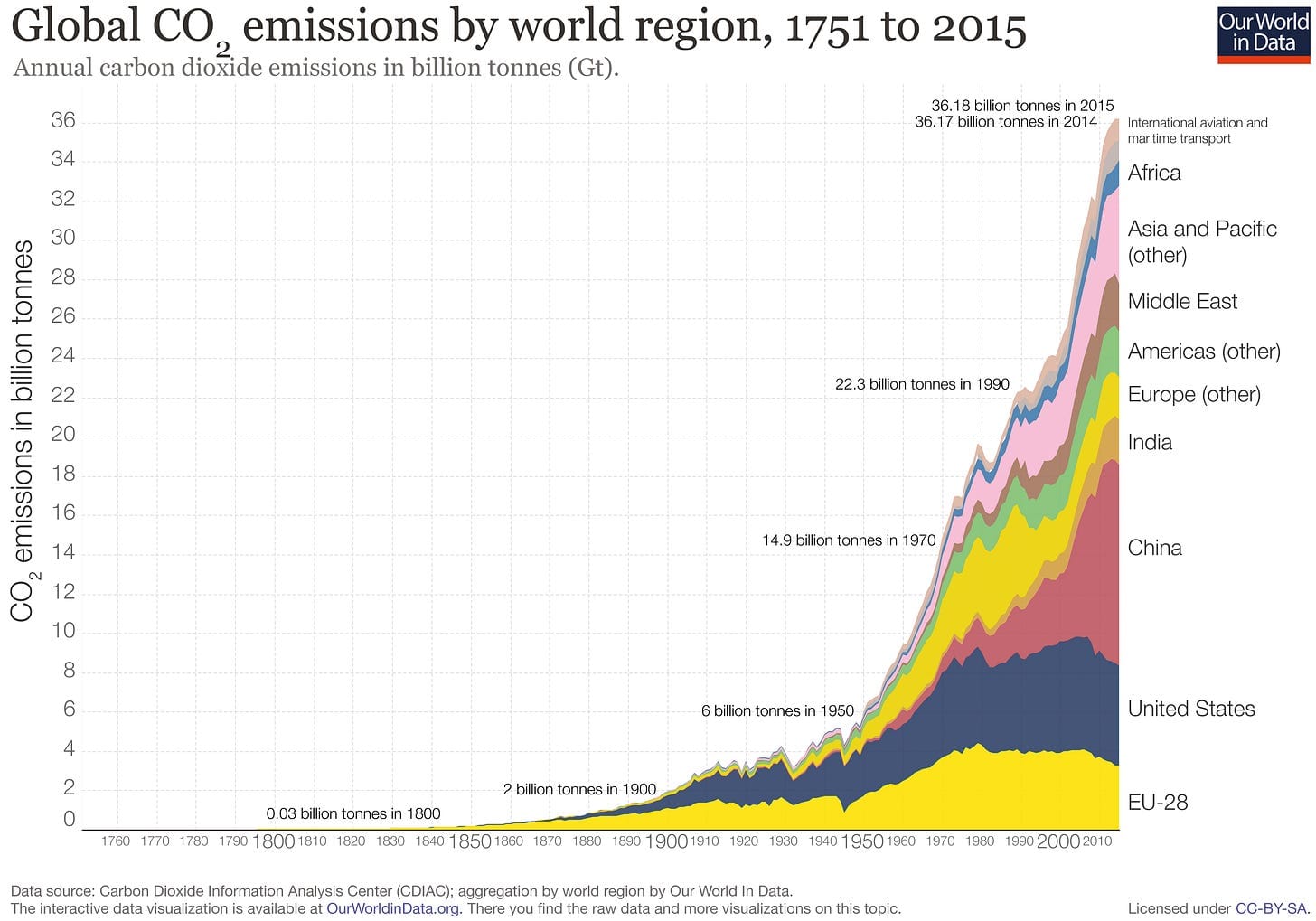
View ourworldindata.org for an interactive data sheet.
Anyway taking this back out to a macro perspective, as soon as farming was adopted as a way of life, humans have been becoming exponentially more and more out of balance with their environments. With each new development that is adopted we also close the door behind us. From farming there was no way back to hunting and gathering due to population growth. From farming to industrialisation there is also no way back due to population growth. The book Guns, Germs & Steel by Jared Diamond explains this well.
My personal thoughts are that we should not seek de-growth, to live in the past and give up what has already been created. To do so would require a ‘Thanos solution’ where many people would die and where life expectancy would decrease.
If we ‘fail’ in creating better tools, tools that can keep our civilisation running, stopping emissions, and then reversing emissions, then by default what is left is what survives and will exist in a simplified, de-growth state.
This is where I do agree with Project Drawdown (100 solutions to get humanity to negative emissions) and RethinkX: “We should not seek to use no tools, but build and use better tools.” I think their vision is overly optimistic from a time prospective (transforming: food, power and transport for the whole world by 2030), but interesting: RethinkX on YouTube
We should identify and scale at speed the best technologies we can as we simply don’t have the: space, resources, time or land for everyone to become small holder farmers and hunter-gatherers again.
De-growth disadvantages:
We could be on track to have the technology to spot and defend our planet from the type of asteroid impact that ended the dinosaurs, de-growth means giving up on the possibility of that safety net.
What if a group of humans, say a small island nation did not follow the de-growth model, but the rest of the world did. After 50 - 100 years that small country's technology could put them 500 years ahead of the rest of the world's population. How would that technologically advanced nation treat the rest of the world? Look what the UK did to the known world during its largest technology gap for a possible example.
I am certain now that we will not keep below the 1.5C threshold, and probably not 2C either.
Catastrophic, all-pervasive, climate breakdown is now inevitable.
#COP26 #COP26Glasgow #ClimateEmergency #Climate @COP26 @guardianopinion @guardianeco @the_ecologist @RHarrabin
— Bill McGuire (@ProfBillMcGuire), Wed Nov 10 10:53:57 +0000 2021 source
Now this is just one take and I have picked just a few moves on the chess board to illustrate the point that we will continue to fail in cutting global emissions; I could have picked many more. I’m writing this as a snapshot, showing one of the things that I’m thinking about in late 2021, and running with this idea to VERY dubiously extrapolate a possible outcome.
Anyway enough of the scene-setting, let's try and guess what human civilisation will do when the crisis hits.
Dubious extrapolation - The COVID response
COP27 and so on will continue to fail. Humans will continue to emit more and more greenhouse gases. Our populations will continue to grow and the time that our yearly allocation of Earth's resources is used up will continue to shrink. See Earth Overshoot Day which in 2021 was reached on the 29th of July. The full data can be found here: data.footprintnetwork.org.
Quickly we reach a point where everyone is being noticeably impacted, tipping points exceed what science predicts (as has happened many times in recent years). People are impacted in many ways:
- Extreme weather
- Crop failure
- Lack of pollinating insects
- Lack of clean drinking water
- Sea level rise and so on.
This has already started for many small island nations, and parts of the global south, but will be hitting everyone by the 2030s. Humans in a crisis will look for any way to get out they can, creating a global migration crises and wars on multiple fronts around the world.
Many people come to the conclusion that when the climate crisis really gets going, be it in the 2030s or in a few hundred years from now that we are just doomed and everything will fall apart. Maybe humans do not become extinct, but our civilisations will die along with most of the world's population.
Here I’m going to hypothesise something different or at least at first. Wealthy nations, instead of letting nature take its course and leading to the rapid collapse of civilisation, will try to implement last-minute, dangerous and rapid control measures. Most likely in the form of ‘Geoengineering’ through the deployment of ‘Stratospheric Aerosol Injection’ (SAI) technology.
Geoengineering - Stratospheric aerosol injection
Seeding the world's stratosphere with reflective particles creating global cooling and buying time, but it will also create yet more erratic and unpredictable outcomes, many of which scientists will likely not know the full extent of at the time the first planes begin carrying these chemicals into our upper atmosphere.
The two videos below give an idea of this technology and its positive / negative possibilities:
(There are other Geoengineering possibilities besides SAI, but SAI is cheap)
Currently it seems that Geoengineering is universally hated. People that are working to find climate solutions and fight against fossil fuels hate to even contemplate this possibility due to its many negative side effects that may be worse than global warming. On the other side the fossil fuel industry also hates this idea. Researching it would show that they are disproportionately responsible for the climate crisis we face now.
It seems there is very little research going into Geoengineering around the world and not much funding for it. China has maybe the largest R & D invested in Geoengineering and weather modification technology. The Chinese Communist Party (CCP) up until now have been quite happy and confident in their ideas about controlling and improving on nature and if this scenario plays out, they are well placed to lead the world in implementing SAI-style projects:
https://www.theguardian.com/world/2020/dec/03/china-vows-to-boost-weather-modification-capabilities
A 2017 plan earmarked $168m (1.15bn yuan) for four new planes, eight upgraded craft, 897 rocket launchers and 1,856 digital control devices to cover 370,000 miles (960,000 sq km), about 10% of China’s territory.
https://etcgroup.org/content/chinas-plan-engineer-himalayan-clouds-geoengineering-unintentional-or-otherwise
If it works as advertised, China’s Sky River project could give the country significant control over the water supply that about half of the world’s population depends on. The Tibetan plateau feeds not only the Yellow and Yangtze rivers that flow through China, but also the Mekong, Salween and Brahmaputra rivers, which are important for Myanmar, Thailand, Laos, Cambodia, Vietnam and India.
The above articles are not related to China implementing SAI, but rather weather modification by cloud seeding. Their larger projects are likely to impact the rainfall in other countries. Still it puts them in a good position to put forward a SAI plan when China becomes heavily impacted by the climate crisis.
Some estimates say that the cost of SAI would not be high, that a single billionaire could afford to fund a wave of SAI. This means that most of the world may not get a say in the implementation of this technology. So an individual nation could take it upon themselves to do this if they were not stopped by force from other nations.
It's hard to know how much time a technology like SAI could be used to control global temperature while humans continue to emit greenhouse gases into the air. So if we use this we would at the same time have to radically change our civilisation or we are just kicking the can down the road and delaying that climate catastrophe doomsday.
Would SAI even work or just make things worse with acid rain and other side effects? Would the effects of SAI be uniform around the world or affect different areas differently? So many questions!
Questions for the reader:
- Is the combination of unaverted climate change plus the deployment of SAI a realistic possibility?
- If yes, does this possibility impact your planning for the future?
If you are or were:- Expecting civilisation to collapse between 2030 & 2050
- Liking the idea of Geoengineering
- Want to prevent any consideration or research into Geoengineering
- Something else.
How do you plan for the future with the possibility of SAI being deployed?
- If no, what is a more likely outcome for our future?
- If SAI is implemented and it brings down global temperatures enough to create some stability (after most people have had some first-hand experience of living with the climate crisis). Will we as a global civilisation be able to allocate enough resources to transform our existing civilisation into a negative emissions society?
I’m not advocating for the use of SAI in writing this, it could do more harm than good. I would be happy to see more research on it before the possible deployment of such technology becomes inevitable. There are also many things that could come about before the 2030s that could void this hypothesis. But I will save that for another post. Some people reading this might be tempted to see hope for civilisation from this idea.
I would caution against optimism for such a powerful technology that once deployed could not be undone and may require the continuous deployment of it for centuries to maintain stability.
Peace, Eben